Real Bass electric bass guitar
- 4.5
- Rating
- 10.00M
- Installs
- Free
- Price
 Analysis by App-foxy
I approached Real Bass as a quick way to practice bass ideas without carrying an instrument around, and I came away seeing it as more than a simple music toy. It is a touch-based bass guitar game from Kolb Apps, built around learning riffs and playing along with lessons. That combination makes it useful for beginners who want to understand where notes sit, casual players who enjoy rhythm games, and bassists looking for a convenient way to keep their fingers and ears involved between proper practice sessions.
The important distinction is that this is not a replacement for a physical bass. Your phone cannot reproduce the feel of strings, the resistance of frets, or the small timing corrections that make a real performance sound good. What it can do is remove the setup barrier. I can open it during a short break, try a pattern, and repeat a difficult passage without plugging in an amplifier or worrying about disturbing anyone nearby. That convenience is the central reason to try it.
How the current version feels in everyday use
The current release is version 7.33.11, and the app has been available since June 18, 2012. That long history matters because Real Bass feels like an established product rather than a newly launched experiment. It has attracted over ten million installs, while its average rating sits at 4.5 from roughly eighty-six thousand ratings. Those figures do not guarantee that every player will enjoy it, but they do suggest that the basic idea has remained appealing across a wide range of Android users.
You May Also Like

 Blood Strike: 2.5 Anniversary
Blood Strike’s Loadouts Turn Every Drop Into a Tactical Gamble
A close look at Blood Strike’s custom loadouts: how fast access to signature weapons reshapes its battle royale rhythm, rewards preparation, and narrows the gap between fights.

 Pandora - Music & Podcasts
Pandora’s Music Is Easy to Start, but Harder to Recover
Pandora’s strength is its low-effort path from a seed to a station. Its weak spot is how much confidence it asks you to place in connection, setup, and quiet recovery.

 8 Ball Pool
 Is Built on Rivalries, Rematches, and Routine
A close look at the rivalries, rematches, shared routines, and unanswered safety questions that turn a quick pool match into a persistent mobile community.

 Samsung Music
’s Quiet Strength Is Playing What You Already Own
Its reach comes less from spectacle than from dependable access to a personal library. That simplicity is both the app’s strongest retention engine and its ceiling.

 AccuWeather: Weather Radar
AccuWeather Review: A Quick, Clear Forecast for Everyday Decisions
For everyday plans, the best forecast is the one you can understand quickly. AccuWeather makes rain timing, radar, and local conditions easy to act on, with a few trade-offs.

 Hill Climb Racing
Why Hill Climb Racing Still Turns Crashes Into One More Run
A tiny car, a bumpy hill and one more upgrade: Hill Climb Racing keeps resurfacing because its simple chaos makes every near-miss feel personal.
More From Our News Desk
View All News


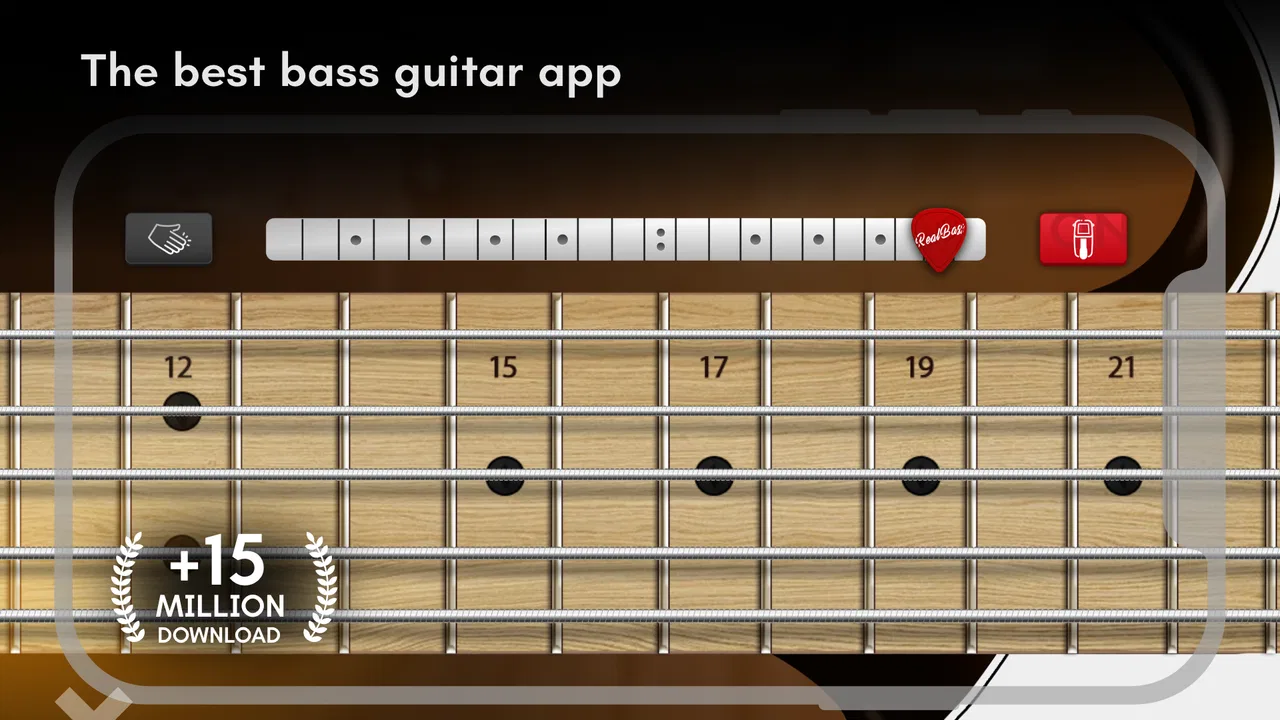
Getting started is straightforward. The screen presents a virtual bass layout that you play by tapping and interacting with the displayed strings or notes. The first few minutes are best spent simply learning how the touch response works. I found that looking at the note positions before trying to play quickly made the experience less frustrating. Beginners often want to jump straight into a recognizable riff, but a little orientation first helps prevent random tapping from becoming the whole experience.
The game sits in the music category, although I would describe it as a hybrid of a virtual instrument, a lesson aid, and a casual rhythm game. That mixture is its strength and also its limitation. If you expect a complete course with detailed theory, posture guidance, and personalized correction, it will feel light. If you want an approachable way to explore bass lines and practice timing, the format is much more convincing.
One useful habit is to treat each session as a small musical exercise rather than a score chase. I like beginning slowly, identifying the repeating shape in a riff, and only then trying to increase my pace. On a phone, visual memory can take over quickly, so I occasionally look away from the controls and listen to whether the sequence still sounds even. That simple change makes the app more useful for learning instead of merely memorizing where to tap.
What the lessons are good at
The lessons and riff-focused approach give new players a reason to keep returning. A blank virtual instrument can be interesting for a few minutes, but a guided task creates direction. When I use the app with a specific goal, such as repeating a short bass phrase cleanly several times, the session feels more purposeful. It also helps someone who has never held a bass understand that bass playing is often about steady timing and controlled repetition rather than filling every moment with notes.
There is a practical benefit for people who are considering buying a bass but are not ready to commit. Real Bass lets you test whether the role appeals to you: do you enjoy holding a groove, repeating a pattern, and listening for small timing differences? That answer is more informative than simply watching a performance. It cannot tell you whether you will like the physical instrument, but it can reveal whether the musical mindset interests you.
For an existing bassist, the app works best as a mental rehearsal tool. I would not use it to judge my real technique, but I can use it to remember the order of notes in a riff, sketch an idea while traveling, or keep a rhythm pattern fresh when my instrument is unavailable. The phone interface is especially convenient when the goal is recall rather than tone.
Small workflow changes that improve the experience
One of the less obvious ways to use it is as a two-stage practice aid. First, I work through a riff visually until the sequence is familiar. Then I repeat it while concentrating on consistent spacing between notes instead of staring at every movement. This exposes a common weakness in mobile music games: a player may learn the visual route without developing a reliable sense of pulse. Switching attention from the screen to the sound makes the exercise more musical.
Another useful approach is to divide a longer practice period into very short rounds. Touchscreen accuracy can decline when I rush or keep playing after losing focus. A short attempt, a pause to identify the mistake, and a fresh attempt usually works better than repeatedly forcing the same passage. This is particularly helpful for children and first-time players, because progress becomes easier to notice when the target is one clean phrase rather than an entire song.
I also recommend using headphones when the environment allows it. They make the notes easier to follow in a noisy room and reduce the temptation to play with exaggerated taps just to hear what happened. The app becomes less of a public performance and more of a private timing exercise. That difference is small, but it changes how carefully I listen.
A final tip is to keep the phone stable. Holding it in one hand while playing with the other can make the controls feel less predictable, especially during faster patterns. Resting it on a desk or another flat surface gives both hands a more consistent position. This is not a glamorous feature, but it is the kind of practical adjustment that prevents avoidable frustration.
How the product has evolved and what that means
The release history gives Real Bass a different context from a short-lived novelty app. Since its original release in 2012, it has continued to receive updates, with version 7.33.11 representing its current state. I would read that evolution as evidence of ongoing maintenance rather than proof that it has become a full professional music workstation. The core identity remains clear: a compact bass-playing experience focused on accessible lessons and riffs.
For someone installing it today, the benefit of that maturity is familiarity. The concept does not need a long explanation, and the app is aimed at getting you to the instrument quickly. At the same time, a product with a long life can feel less ambitious than newer specialist tools. Real Bass is most convincing when judged as an easy entry point and practice companion, not against desktop recording software or a detailed hardware simulator.
The current version supports devices running Android 7.0 or later, which keeps it available to many people using older phones. That is helpful if you want to turn an unused device into a small practice screen. It also means the app is not aimed only at people with the newest hardware. For a music game, broad device access is valuable because convenience disappears if the app can only be installed on a recent flagship.
Existing users should therefore expect continuity more than a complete reinvention. The app’s main promise remains playing bass parts through a touch interface and following lesson-oriented material. If you already enjoy that format, the current version should feel like a continuation of the same idea. If you were hoping for a radically different learning system, a physical-instrument companion, or a studio-style environment, the version number alone should not create that expectation.
Where it fits beside ordinary alternatives
Compared with a real electric bass, Real Bass wins on portability, silence, and immediate access. A physical instrument wins decisively on touch, dynamics, muscle memory, tuning awareness, and the relationship between both hands. I can use the app in a waiting room; I cannot realistically do the same with an amplified bass. But the app cannot prepare my fingertips for strings or teach the exact coordination required to fret and pluck a real instrument.
Compared with watching free bass tutorials, the app offers more direct interaction. A video can explain technique and show a player’s hand position, while Real Bass gives me something to operate. The trade-off is depth. A good instructor can notice tension, correct posture, adjust the pace, and explain why a line works harmonically. The app is better for immediate repetition; a teacher or carefully chosen lesson series is better for correcting technique and building a structured path.
Compared with a generic rhythm game, this one has a clearer musical identity. The focus on bass riffs makes the practice feel connected to an actual instrument rather than only to matching prompts. On the other hand, someone who wants elaborate progression systems, competitive play, or a large variety of unrelated musical challenges may prefer a broader rhythm title. Real Bass is narrower, and that focus is either an advantage or a drawback depending on what you want from a game.
It also differs from a recording or digital audio workstation. Those tools are designed for arranging, editing, and producing music; this app is designed for playing and learning within the app itself. I would use a workstation to build a finished track and Real Bass to explore a riff during a spare moment. Treating them as substitutes would lead to disappointment.
Who should use it, and who should skip it
I think it is a strong fit for a beginner who wants a gentle first contact with bass. It is also suitable for a parent looking for an age-friendly music game, since the content rating is Everyone. A curious listener can use it to discover whether bass lines are enjoyable before buying equipment, and an experienced player can use it for quick recall practice when a physical instrument is not available.
The free entry point is another reason it is easy to recommend for experimentation. Real Bass is free to install, while optional in-app purchases range from $1.99 to $18.99 per item. I would begin without spending anything and decide whether the interaction is genuinely useful before considering extras. That is especially important because a virtual instrument can be fun immediately but may not become part of your routine.
I would skip it if your main goal is formal bass education. You will need a real instrument, a metronome-centered practice plan, or instruction that can address technique in detail. I would also look elsewhere if you want to record polished bass parts, connect a physical instrument, or study advanced harmony. The app’s simplicity is valuable for access, but simplicity also sets a ceiling.
Players with limited patience for touchscreen controls should try a short session before deciding. The interface cannot provide the physical feedback that makes a real bass satisfying, and fast passages may feel more like coordination tests than authentic playing. Likewise, if you want a game with a strong competitive or social focus, the lesson-and-riff orientation may seem too solitary.
A realistic day-to-day example
Imagine that I have ten minutes before leaving for work and no time to set up my bass. I open the app, choose a lesson or riff, and spend the first minute checking the note layout. I then play the phrase slowly, pause after an uneven attempt, and repeat it while listening for a steady pulse. In the final few minutes, I try it without watching every tap. That session will not replace proper practice, but it can keep a musical idea active instead of letting an entire day pass without touching anything related to bass.
Another scenario is a beginner sharing a home with other people. Practicing a physical instrument may be inconvenient late at night, while a phone-based session can be quiet and brief. The learner can use the app to remember a sequence or build basic rhythmic awareness, then transfer that understanding to a real bass later. The transfer will not be automatic, but the app can make the first real session less intimidating.
Remaining gaps and what I would watch next
The biggest gap is the distance between tapping a screen and playing strings. No amount of virtual convenience changes that. A learner can become comfortable with note order and timing in the app while still struggling with pressing, plucking, muting, and shifting on a physical neck. I would treat every successful mobile session as preparation for musical thinking, not as proof that real-bass technique is already developing.
There is also a possible ceiling in motivation. Lessons and riffs provide structure, but players who need a long-term curriculum may eventually want clearer milestones, deeper explanations, or more individualized feedback. That does not make the current experience poor; it simply means the app is better at starting and supplementing practice than at serving as a complete teacher.
Touchscreen play can introduce its own habits. I sometimes focus too much on hitting the correct location and not enough on whether the phrase breathes naturally. A useful safeguard is to alternate between visual accuracy and listening-based repetition. If the app becomes a sequence-matching exercise with the sound ignored, I am no longer using its musical potential well.
Because optional purchases are available, I would also pay attention to how much of the experience feels comfortable before buying anything. The free version is the sensible testing ground. A purchase should solve a clear personal need, such as wanting more material or a feature I will use repeatedly, rather than being an impulse triggered by a difficult riff.
Looking ahead, I would value improvements that strengthen the bridge between virtual practice and real playing: clearer guidance on transferring a riff to a physical bass, more help with timing habits, and feedback that explains why a passage sounds uneven. Those are expectations, not claims about the current product. What is already clear is that the app’s future usefulness will depend on preserving its quick accessibility while offering more depth to users who outgrow the basics.
My final recommendation
After using it as a compact practice tool, I see Real Bass as an approachable and practical music game rather than a full bass course. Kolb Apps has kept the concept focused: open the app, learn a riff, and play it through a phone-based bass interface. Its free price and Everyone rating make it easy to try, and its long availability suggests that the format has lasting appeal.
My honest recommendation is to use it as a bridge, not a destination. It is excellent for short sessions, first experiments, quiet practice, and remembering musical patterns. It is not the right choice for mastering physical technique, producing recordings, or replacing an instructor. If you understand that boundary, the app can earn a useful place on your phone.
For me, its best quality is the reduction of friction. I do not need an instrument case, an amplifier, or a long block of free time to engage with a bass line. I can practice a small idea and return to it later. That will never equal the experience of playing a real bass, but it is enough to make music more available during ordinary parts of the day—and that is a worthwhile reason to give this particular game a try.
FAQs for Real Bass electric bass guitar
01What features does the Real Bass app offer?
Real Bass provides a realistic bass guitar experience with multiple fretboard options and sound settings. It includes a variety of bass models, effects pedals, and backing tracks to practice with. Users can customize their playing experience with loop recordings and a metronome for timing, making it ideal for both beginners and seasoned musicians.
02Is Real Bass suitable for beginners?
Yes, Real Bass is designed with beginners in mind. It offers tutorials and easy-to-follow lessons to help new users learn the basics of playing the bass guitar. The app also features adjustable difficulty levels, allowing users to gradually improve their skills at their own pace.
03Can I use Real Bass without an internet connection?
Real Bass can be used offline, allowing users to jam and practice without needing an internet connection. However, some features like downloading additional content or updates may require connectivity. This offline capability makes it convenient for practicing anywhere, anytime.
04Does Real Bass support recording and sharing music?
Yes, Real Bass allows users to record their sessions and save them directly to their device. These recordings can be easily shared with friends or on social media platforms. The app offers high-quality audio output to ensure your recordings capture every note clearly.
05Is Real Bass compatible with all mobile devices?
Real Bass is designed to be compatible with a wide range of Android and iOS devices. However, it’s important to check the app's specific system requirements on the App Store or Google Play to ensure compatibility with your device, especially older models, to prevent performance issues.
Pros
- Realistic sound quality enhances practice.
- User-friendly interface for easy navigation.
- Wide variety of bass styles and sounds.
- Customizable settings for personalized play.
- Offline mode available for practice anywhere.
Cons
- Limited free features without purchase.
- Ads can interrupt the practice flow.
- High battery consumption in use.
- Requires ample storage space on device.
- No tutorial for beginners or new users.

Real Bass electric bass guitar
Gallery